
The timesheet trap: why consultants confuse hours, billing and value
Timesheets aren’t just admin. They sit at the intersection of effort, billing, and contracts. This article unpacks four types of time, why they often differ, and the simple test that helps consultants record time honestly, bill correctly and apply better commercial judgement.


In my early days of consulting, I thought a timesheet was an administrative chore invented to ruin Friday afternoons. Turns out it is a commercial document that can also ruin Friday afternoons :) It appears for so many, timesheets are not a thing of beauty (see my article on timesheet without the tears). I very regularly get questions about timesheets….
"I worked ten hours, the contract allows eight. What do I do?"
"The client pays the same either way, so why does it matter?"
These sound like administration questions. They are fundamentally commercial questions.
Consultants, and often their firms, treat a time recording system and a billing system as one thing. In fairness, they usually are one system. But they are not the same thing.
They are not the same.
Four types of time, and they are rarely the same number
- Available time is your capacity. Around 260 working days, less public holidays and leave. Call it 220 in a good year.
- Worked time is what you actually did. Delivery, proposals, learning, helping a colleague. Your whole contribution across the ConsultantCafe 5 Cs (formerly the 4 Cs), almost none of which comes with a job code, which is why the busywork you did to feel productive never shows up anywhere.
- Billable time is what the contract permits your firm to charge for an assignment or engagement. Set by the commercial arrangement, not by how hard you worked. Where that arrangement comes from is costing versus pricing.
- Billed time is what lands on the client invoice, after discounts, write-offs, and decisions made in meetings you were not invited to.
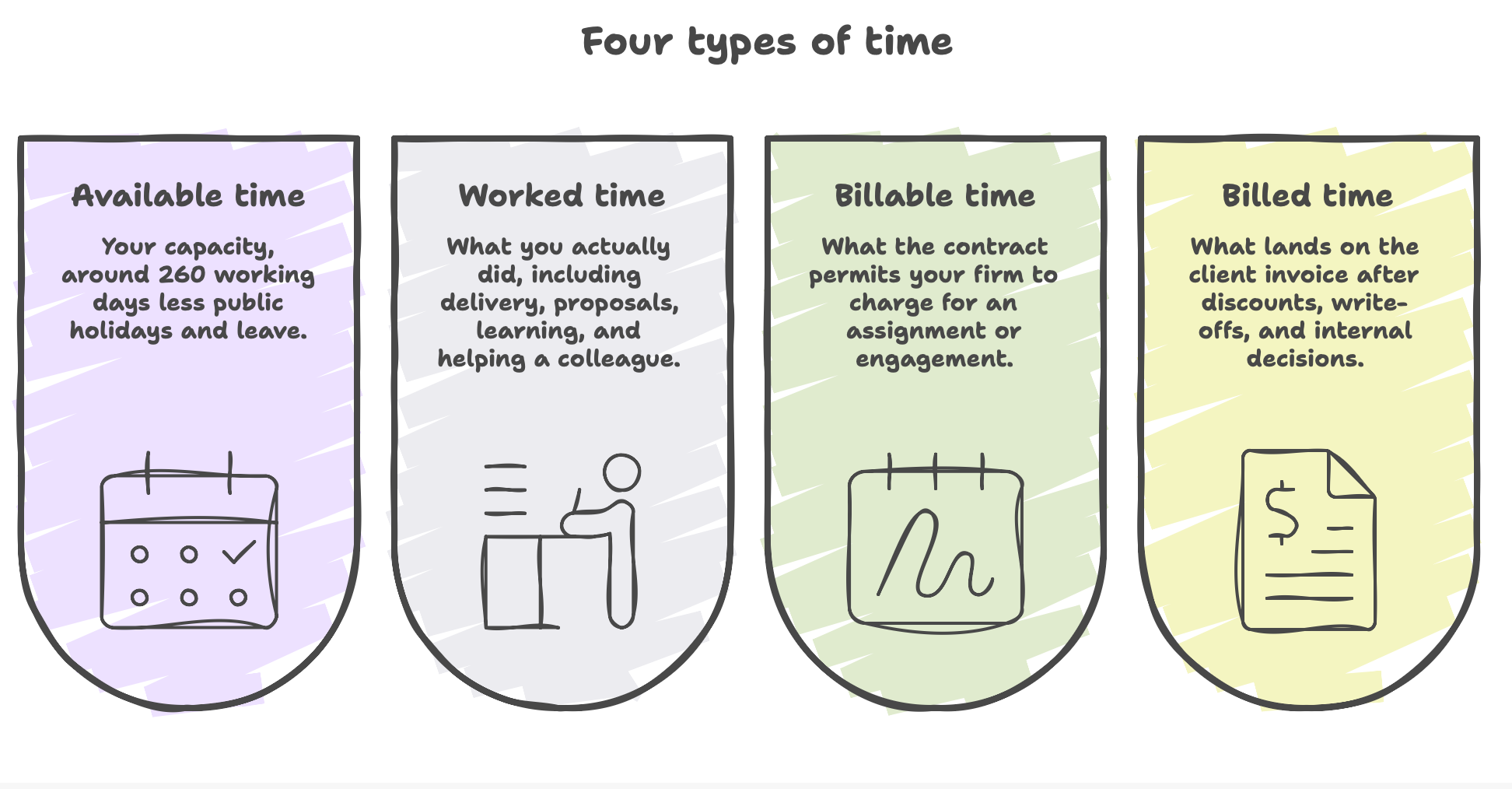
Those four records can match. They can also all differ in the same week.
Assuming they should all be identical every hour, day or week would be a mistake.