
Crack the code of consulting. My 5Cs of Consulting
ConsultantCafe 5C framework for a balanced career.

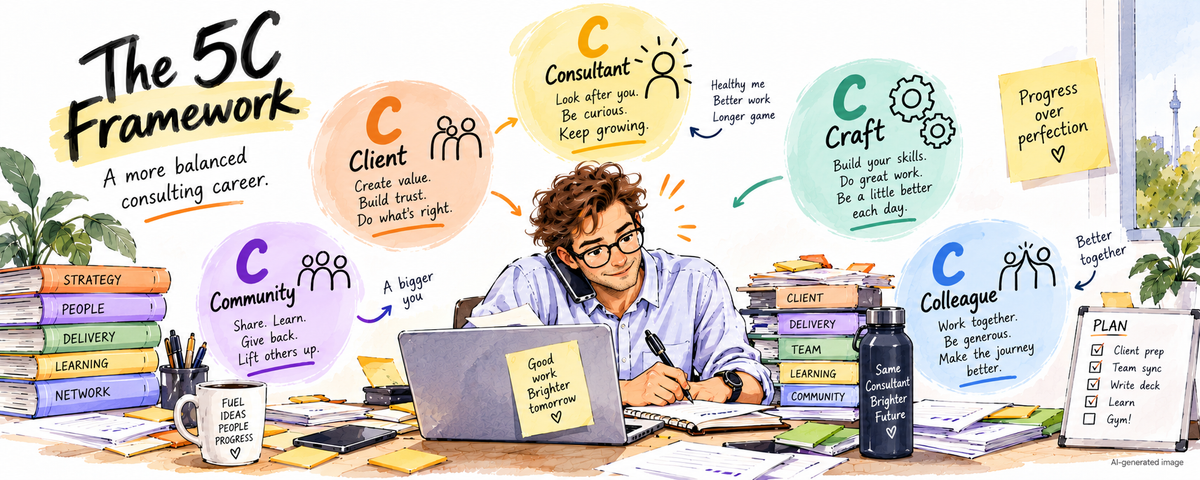
When I wrote the 4 Cs of consulting framework article, I thought I'd covered it. Consultant, Colleagues, Clients, Community. Caffeine, calls, and charge codes were the joke version I opened with, but the proper version has held up well enough that I've used it and referenced it frequently.
Then I looked at what I've published this past year. A change management playbook. A tube map with 89 methods on it. Costing versus pricing. Delivery certainty framework. Status reports. And so much more. Almost all of it is consulting craft, and craft didn't have a C of its own.
I have decided that knowing yourself and being good at your job are two different things.
One needs a mirror. The other needs practice.
So, 4Cs has become 5Cs.
1. Consultant
What it is. Your mindset, your strengths, the handful of things you do better than the people around you because you are you. Also your relationship with your own worth. What you believe you can do, what you stand for, and what you're willing to charge for it.
Why it's important. This is the hardest of the five Cs, because it means holding up a mirror and liking what you see, when most of us would sooner reorganise our inbox. Skip this C and the joy in consulting goes first, then the energy. You end up a generalist by accident instead of a specialist by choice, saying yes to everything because you've got no grounds for saying no. You can't price, pitch or defend a strength you've never sat down and named. This is the C that decides whether you choose your next role or take the one you're handed.
What good looks like.
- You can say your three strengths out loud without softening them, with an example of each.
- You turn down work that'll build neither your skill nor your reputation because you get plenty of opportunities that leverage your consulting superpower.
- Your rate is a decision you made, not a number somebody gave you.
2. Craft (or Capability)
What it is. This is your ability to practise consulting well. It includes the methods, tools and professional disciplines you draw on. It is knowing how to think through a problem, structure the work, communicate clearly, run a room, and adapt your approach when the standard method does not fit.
Why it's important. Craft is what separates a consultant who can follow a method from a consultant who can truly run an engagement.
It is the ability to work through ambiguity and shades of gray, manage the client, the commercials, the work and competing stakeholder views, all at once. Technical expertise matters, but craft is knowing when to follow the playbook, when to adapt it, and when to leave it behind.
Craft turns expertise into effective consulting.
- You bring clarity to messy problems and make sound calls when there is no obvious answer.
- You know the method well enough to use it, adapt it or even abandon it when the situation demands.
- You keep the client, the commercials, the work and stakeholder interests aligned throughout the engagement.
3. Colleagues
What it is. The people you work with, learn from, rely on and help along the way. Consulting can reward individual performance, but most good work is built with other people.
Why it’s important. Working with your colleagues is a force multiplier for delivered work. Your colleagues help you when the work gets hard, challenge your thinking, and push you to make the work and the deliverables better. They fill your gaps, test your assumptions and often see things you do not.
They also see how you really work, how you respond to pressure, how you treat people and whether you make the team stronger.
Clients may remember the outcome. Colleagues remember what it was like to work with you. That reputation follows you.
What good looks like.
- You are someone colleagues want to invite onto their engagements because you make the work and the team better.
- You share work early, invite challenge and use team to make deliverables stronger.
- You share what you know, support others when they need it, and build relationships that last beyond the engagement.
4. Clients
What it is. The reason any of this exists. A client lets you into their organisation to solve something they can't solve alone, or don't want to solve alone. Your job is to make them right for having asked.
Why it's important. Your career grows in proportion to the value you create for them, not the hours you bill against them. Understand the problem behind the brief, leave something that still works after you've gone, and the reputation follows. Client trust is the one asset that travels with you between firms. Trusted consultants get handed the ambiguous, career defining problems.
What good looks like.
- You earned trusted advisor status. The client tells you things they haven't told the steering committee.
- You've delivered news they didn't want to hear, and been asked back.
- You can state their definition of success in one sentence, and they agree with it.
5. Community
What it is. Your community is the wider world you belong to: peers, industry, and the people who matter beyond the job. Giving back in small ways creates powerful ripples and makes you a better consultant.
Why it's important. Most underrated of the five, and the easiest to talk yourself out of. On your own you think you can't make much difference. If every consultant gave back a little time, expertise or money, the effect would be enormous. Giving back grows your empathy and your sense of why you do this at all. None of it turns up on a KPI and all of it makes you better at your job. It builds you a reputation your firm doesn't own, which is the one you need the day you change roles, raise your rates, or go out on your own.
What good looks like.
- Somebody outside your firm can tell who you are and what you stand for.
- You give without a clear line of sight to what comes back.
- You get invited to things your job title doesn't entitle you to.
The bill for going all in on one
I speak from experience when I say that there is a cost of investing too much in one of the 5Cs alone. The costs look like this.
- Consultant only. Self aware, and alone.
- Craft only. Superb at the job, invisible commercially. Beautiful work nobody bought.
- Colleagues only. Popular, consulted by everybody, behind on your own deliverables, billables, training or something else.
- Clients only. Available at all hours. Resentfully burnt out.
- Community only. Known everywhere, booked nowhere.
Boredom, burnout, or becoming the consultant everybody avoids. Take your pick.
Five practical tips
- Know what you are best at, and be able to say it clearly.
- Choose something to get better at, then deliberately work at it.
- Make someone else’s work better through your input, challenge or support.
- Tell clients what they need to hear, even when it is uncomfortable.
- Give something back without expecting anything in return.