Spot your common consulting bias
The smartest consultants aren’t the ones who are right the most. They’re the ones who notice when they’re wrong the fastest. Spot these biases fast, before they undo your deliverable

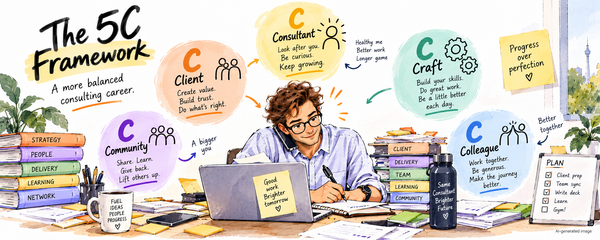
Consultants pride themselves on clear thinking, yet our minds are often fogged by the very biases we try to help clients see. Bias is the invisible fingerprint on every analysis, conversation, and slide we produce. You cannot scrub it out entirely, but you can learn to spot its mark before it distorts the story. Real consulting starts with catching yourself in the act of being human. That reflection is the first of the Consultant Café 4Cs, "Consultant", the discipline of knowing yourself.
Here are a few to watch out for and how they can show up as you consult.
1. Confirmation Bias
Context:
Confirmation bias is the tendency to seek out, interpret, and remember information that supports what we already believe. In consulting, it’s the quiet slide shuffle that favours data proving our hypothesis while quietly ignoring anything that challenges it. Once a narrative forms, every interview, spreadsheet, and finding starts to fit the story we want to tell — even when reality disagrees.
Effect on Consulting:
Confirmation bias blinds consultants to the complexity of the problem they were hired to solve. When we search only for evidence that supports our early diagnosis, we risk missing signals that point to deeper or entirely different causes. Clients sense this. They feel unheard when their experiences or data are filtered to fit a pre-written conclusion. Over time, credibility erodes and recommendations become self-referential rather than insightful.
How to Avoid It:
Treat every working hypothesis as a question, not a verdict. Actively look for data that could disprove your assumptions. Ask, “What would I expect to see if I’m wrong?” Run “red team” reviews where a colleague challenges your reasoning from a fresh perspective. Document both confirming and disconfirming evidence side by side to force balance in your analysis. True consulting rigour lies in curiosity, not certainty.
2. Anchoring Bias
Context:
Anchoring bias is the tendency to give too much weight to the first piece of information we encounter — the “anchor” — and to use it as the reference point for all future thinking. Once that anchor is set, our minds cling to it, even when better data emerges. In consulting, this can happen the moment a client says, “Our main issue is communication,” or a colleague declares, “The problem’s in procurement.” That first framing quietly shapes every interview, analysis, and slide deck that follows.
Effect on Consulting:
Anchoring can trap consultants in narrow definitions of the problem. The initial diagnosis — often based on limited evidence — becomes the lens through which everything is interpreted. This leads to selective data gathering, confirmation of early assumptions, and solutions that address symptoms instead of causes. The result: deliverables that look polished but miss the real issue.
How to Avoid It:
Pause before you accept the client’s first framing. Collect multiple perspectives and deliberately challenge the initial story. Use structured discovery questions (“What makes you think that?”, “What else could be driving this?”) and triangulate evidence before forming conclusions. Encourage your team to treat early insights as hypotheses, not truths.
Anchors are useful for mooring ships, not for guiding thinking. Good consultants know when to lift them.
3. Overconfidence Bias
Context:
Overconfidence bias is the tendency to overestimate our knowledge, accuracy, or ability to predict outcomes. In consulting, it’s the quiet voice that says, “I’ve seen this before. I know how this goes.” You may indeed know the content, but the context has changed. New stakeholders, culture, constraints, or politics. What worked brilliantly in one organisation can flop spectacularly in another.
Effect on Consulting:
Overconfidence can short-circuit curiosity. Consultants can rush to diagnose, skipping the discovery that reveals what’s different this time. Teams can unintentionally dismiss client input or alternative perspectives because “we’ve done this before.” The result is deliverables that don’t fit the environment and deliverables that feel generic rather than tailored. It also erodes trust when confidence crosses into certainty. Clients notice when you stop listening.
How to Avoid It:
Stay grounded in inquiry. Even when you’ve seen a pattern before, ask yourself, “What’s the same, and what’s not?” Revisit your assumptions and involve people who see the system differently such as clients, peers, and end users. Use premortems (“If this fails, why might that be?”) to test whether your confidence is earned or imagined. Remember: expertise gives you a starting point, not a shortcut.
Consulting Tip: trust your instincts. Listen to them, even if your mind is saying “I’ve got this”
Great consultants don’t tone down their confidence; they anchor it in humility. Context, not content, is what separates a good answer from the right one.
4. Availability Bias
Context:
Availability bias is our tendency to judge situations based on the information that’s easiest to recall, ie the thing that is most recent, vivid, or emotionally charged. In consulting, it often shows up when the last client problem, headline, or war story dominates how we interpret the next one. The mind takes a shortcut: “It looked like this before, so it must be the same now.” Ease of recall doesn’t equal accuracy.
Effect on Consulting:
Availability bias can distort both analysis and advice. Consultants may overemphasise risks they’ve recently seen (“This reminds me of that project that blew up…”) or underplay issues they haven’t experienced firsthand. It can drive a false sense of certainty in decision-making, especially when time is tight and pattern-matching feels efficient. Deliverables shaped by what’s memorable rather than what’s representative can miss deeper insights, leading clients toward yesterday’s solutions for today’s challenges.
How to Avoid It:
Balance experience with evidence. When a situation feels familiar, deliberately look for what’s different. Ask, “What data supports this comparison?” and “What might I be missing because it hasn’t happened recently?” Broaden your information inputs, review multiple cases, talk to new voices, and check your memory against actual data. Build reflection into project routines so that learning comes from facts, not just from the loudest memories.
Consulting Tip: Take every opportunity you can to ground truth what you see or hear. Seek out other points of view.
5. Groupthink
Context:
Groupthink bias occurs when the desire for harmony or consensus in a group overrides critical thinking and independent judgment. It happens when teams value agreement more than accuracy and when polite silence replaces productive challenge. In consulting, groupthink can creep into workshops, project rooms, and steering committees where strong personalities or time pressure push everyone toward a single, untested view.
Effect on Consulting:
Groupthink limits the quality of analysis and decision-making. When teams fall into agreement too quickly, warning signs are ignored and alternative ideas are dismissed. The result is deliverables that lack depth and recommendations that reflect what everyone was comfortable saying, not what needed to be said. It can also make consultants overly aligned with the client’s preferred narrative, reinforcing their assumptions instead of helping them see blind spots.
I have seen this bias often on change management engagements. The challenge is not just spotting it but turning it around. Once a group settles into shared thinking, it takes careful facilitation to reintroduce curiosity and give permission for people to see things differently.
How to Avoid It:
Create deliberate space for dissent or alternative points of view. Assign someone to play devil’s advocate in workshops or reviews. Encourage team members to voice doubts and back them with evidence. Seek diverse perspectives from different levels, disciplines, and personalities. In meetings, ask, “What might we be missing?” before finalising conclusions. Reflection and challenge should be seen as acts of care, not conflict.
Consulting Tip: Good consultants help teams find clarity through debate. Healthy disagreement is not a threat to unity; it is proof that thinking is alive. Try actually setting up a debate with two points of view to explore them safely.
6. Sunk Cost Fallacy
Context:
The sunk cost fallacy is the tendency to continue investing time, money, or effort into something simply because we have already invested so much. It reflects a natural reluctance to admit that earlier choices may no longer make sense. In consulting, this bias appears when teams cling to plans, tools, or initiatives that are no longer delivering value simply to justify past effort.
Effect on Consulting:
Sunk cost thinking can keep projects on autopilot long after their value has faded. Teams persist with underperforming strategies, outdated systems, or low-impact deliverables because of the resources already spent. It leads to “slide polishing” on initiatives that should be retired and to clients defending legacy projects that no longer align with their goals. The result is wasted energy and reduced credibility when consultants appear unwilling to challenge the status quo.
I have often seen consultants hold onto their deliverables far too tightly simply because they have poured so much energy into them. It is an understandable reaction; the work represents late nights, tough conversations, and intellectual pride. Yet I suspect much of this attachment comes from the sunk cost itself, the more effort invested, the harder it feels to let go. Recognising that impulse is the first step to moving from emotional ownership to professional judgment.
How to Avoid It:
Create regular checkpoints where progress is reviewed against outcomes, not effort. Use clear exit criteria to determine when a workstream or approach should stop. Encourage teams to treat decisions as experiments rather than permanent commitments. When something is not working, frame it as an adaptation rather than a failure. The goal is to recover learning, not losses.
Consulting Tip. You wouldn’t keep reheating old coffee. Pour a fresh cup and start again. Check in regularly on your deliverables objectively to ensure they don't need a change of direction. You don’t need to spend even more time on the wrong thing.
Good consultants know when to persevere and when to pivot. Progress is not measured by how much has been invested; it is measured by how much value remains ahead.
7. Status Quo Bias
Context:
Status quo bias is the tendency to prefer things to stay as they are, even when change might lead to better outcomes. It stems from our instinct to avoid loss and uncertainty. In consulting, this bias often hides behind phrases like “Let’s not rock the boat” or “That’s how we’ve always done it.” The comfort of familiarity can quietly block innovation and improvement, even when the evidence for change is strong.
Effect on Consulting:
Status quo bias can lead consultants and clients to underestimate the cost of inaction. Projects stall because existing processes feel safer than untested ideas. Teams may protect legacy systems or organisational structures that no longer serve the mission simply because they are known quantities. For consultants, this bias can also appear as an unconscious alignment with the client’s existing worldview, resulting in recommendations that are cautious rather than courageous.
I have seen this bias where leaders intellectually agree on the need for change but emotionally resist the disruption it brings. The challenge is helping clients see that maintaining the status quo is not neutral; it is a choice that carries its own risks and costs.
How to Avoid It:
Frame change in terms of progress rather than loss. Compare the risk of doing something new with the risk of doing nothing. Use data, case studies, and prototypes to make the benefits of change tangible. Encourage teams to experiment with small, reversible actions that build confidence. As a consultant, stay alert to your own comfort zones; the status quo can live in your methods as easily as in your client’s systems.
Consulting Tip: “When a client says ‘Let’s keep things as they are,’ ask, ‘What is the cost of staying the same?’”
Last word
Hundreds of cognitive biases quietly shape how we see, think, and decide. No consultant is immune. Anchoring, overconfidence, availability, groupthink, sunk cost, status quo, and the halo effect are only a few of the most common, yet each one can tilt judgment and distort outcomes in subtle ways.
The key is not to eliminate bias, but to recognise it. Every consultant brings their own filters to a project — shaped by experience, success, personality, and context. The most effective consultants learn to spot when those filters are steering the work. They pause, question, and adjust.
Reflecting on bias sits at the heart of the first “C” in the Consultant Café 4Cs: Consultant.
It is where the craft begins — with knowing yourself. Your mindset, your defaults, your blind spots. Awareness of bias is a form of professional hygiene, a way to keep your thinking clean before advising others.
So look for these patterns in yourself and your teams. Notice which biases show up most often in your projects. Reflect on them regularly, not as flaws to fix but as signals to understand. Great consulting starts with clarity of thought, and that clarity begins with you.