Finding Your Consulting Superpower: 10 Ways to Uncover Your Unfair Advantage
In a world where AI and templates are swallowing the middle, being vanilla is a fast track to irrelevance. Your instincts, quirks and eccentric Éclat aren’t flaws; they’re what make you, you

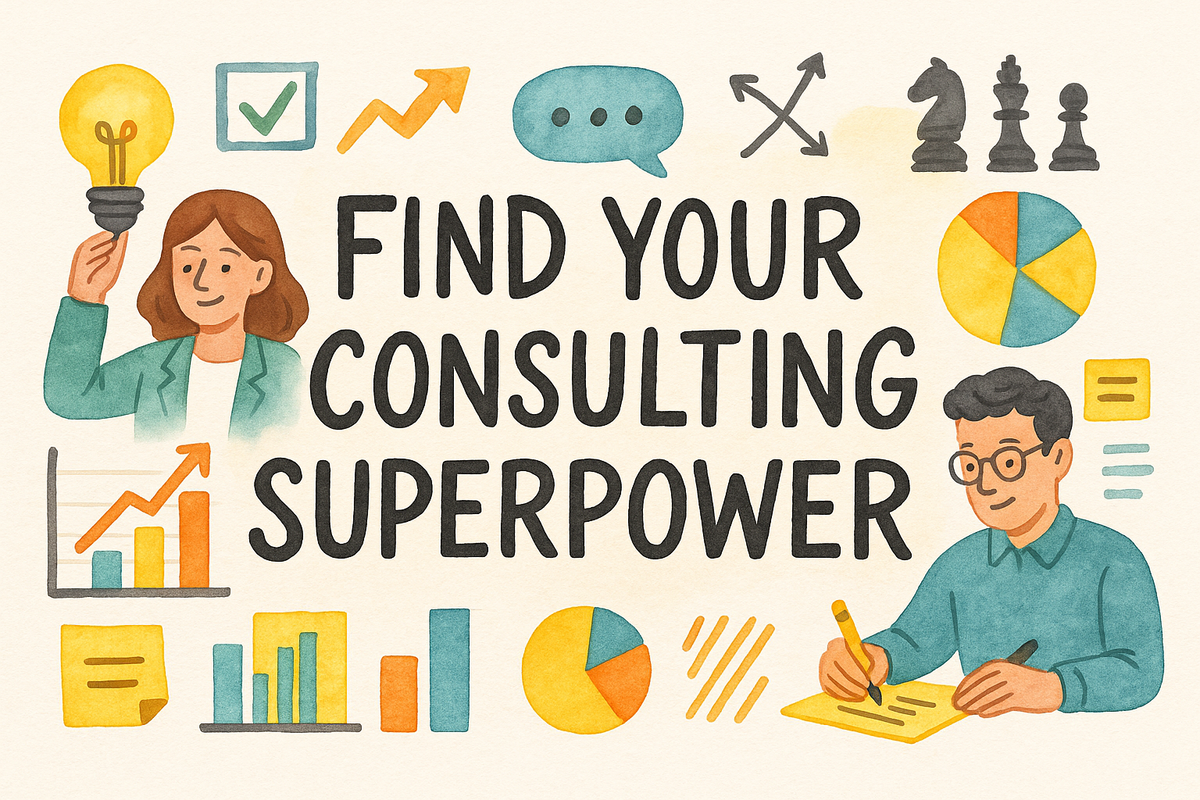
The toughest gig in consulting is holding up a mirror and actually liking what you see. Knowing yourself means understanding your mindset, your natural strengths, and the skills that make you different from the consultant at the desk next to you. It is about finding your consulting superpower, that rare thing you do better than most, and then using it with purpose. It is also knowing your value. It is about recognising that you bring something worth paying for. It takes time, and sometimes a few stumbles to get there.
The trouble is, the performance development process of larger consulting firms tends to sand down the edges that make you remarkable. What starts as a system for growth becomes a factory for sameness, a neat conveyor belt of “high-potential” consultants who all write, speak, and think alike. It rewards conformity disguised as competence, measuring only what can be standardised and quietly discouraging your spark. I suspect this is the case because your counsellor is falsely trying to mould you into who they are, as they were moulded by who their counsellor was….and so on.
The paradox is that these same firms proudly spruik diversity, promising teams that reflect the world they serve, and yet their internal machinery often seeks to produce conformity and sameness. Something I believe weakens the firm, the sector and our collective reputation.
Yet the very thing they teach you to hide, your quirks, instincts, eccentric brilliance and the wonderfully weird, is the authenticity clients actually value. In a world where AI and templates are swallowing the middle, being vanilla is a fast track to irrelevance. Your instincts, quirks and eccentric Éclat aren’t flaws; they’re what make you you.
Worse still, some consultants fall into the trap of wanting to blend in with the crowd. I speak from experience when I say many have mastered the art of invisibility. They’ve learned to blend in, dress alike, talk alike, and never draw too much attention to themselves. It’s a survival instinct disguised as professionalism. The problem is, the longer you practice blending in, the harder it becomes to stand out. You forget that consulting was never meant to be camouflage work, it’s meant to be signal work.
Please hear me when I say being different is good. It’s how you stand out and become “so good they can’t ignore you.” Finding your unfair advantage (your consulting superpower) is about identifying what makes you uniquely valuable and leveraging it with intention. It can feel uncomfortable or lonely to go against the grain after a lifetime of fitting in, but developing your personal consulting brand as a category of one is worth the effort.
Here are 10 ideas to help you discover and harness what makes you uniquely you and a consultant of distinction.
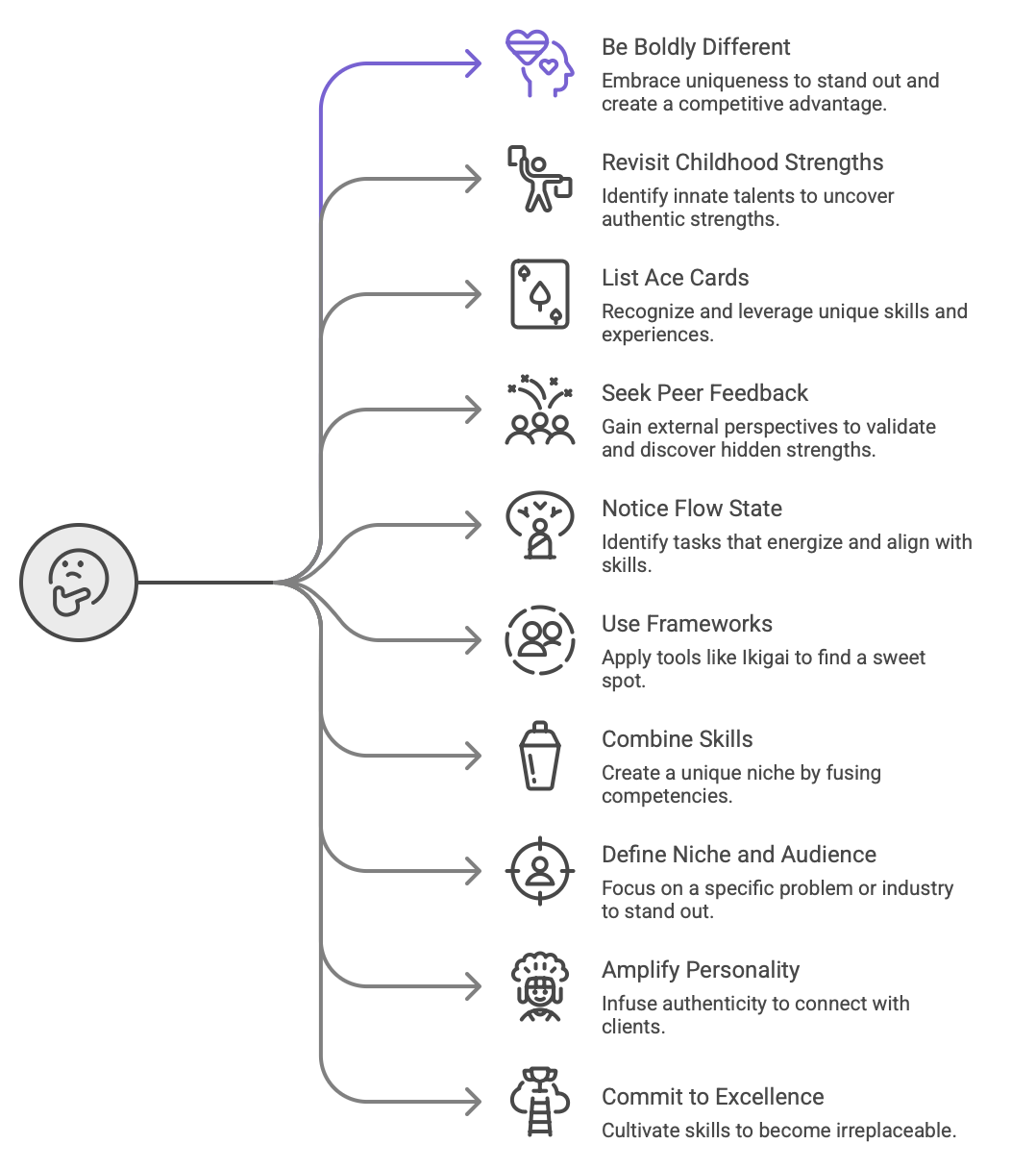
1. Give yourself permission to be boldly different
Stop trying to be vanilla. Accept that not being average is the goal. In fact, career experts note that standing out with a strong personal brand is now essential for consultants. You can’t just do the work and expect to get noticed. Rather than competing to be a generic good consultant, play a different game altogether. Remind yourself that different is good. Recognise that following the same path as everyone else is a slow lane; real strategy is about creating a sustainable competitive advantage by leveraging what only you can offer. It may feel risky or lonely to deviate from the norm, but leaning into what makes you unique is the only way to become impossible to ignore. As Forbes contributor Jodie Cook puts it, to stand out as a coach or consultant, you need a strong personal brand, so give yourself permission to be boldly different.
Consulting Tip: Swap Comparison for Curiosity
Every time you catch yourself comparing your progress to a colleague’s, flip it into curiosity. Ask why their approach works for them, and how your version might look different. Instead of feeling behind, turn comparison into data.
Then take one insight from that reflection and make it your own. Maybe they’re great at stakeholder influence, but your way might be through storytelling or humour.
Remember, comparison drains energy. Curiosity compounds it.
2. Revisit Your Childhood Strengths
Think back to what always set you apart, even early in life. This is a technique consultant John Kim suggests: ask yourself, “What was I naturally good at as a kid?”. Maybe you were the one organising group projects, solving puzzles, or coming up with stories. These innate talents can be clues to your unfair advantage. Our childhood interests and talents often get buried under years of “professionalism,” but they can reveal authentic strengths that feel like second nature. John Kim emphasises that we are all born with unique gifts and inclinations, and identifying those can point you toward skills that others find difficult to replicate. So reflect on your early passions and abilities; you might rediscover a differentiating strength that you’ve undervalued. Those natural aptitudes, the things you did just for fun or excelled at without effort, may be a key part of your consulting superpower.
Consulting Tip: Pick up the phone and call your parents, siblings, or childhood friends. Ask them: When I was a kid, what was it I did that was totally me? They’ll remember things you’ve forgotten — the way you organised every game, built Lego empires, made up stories, or mediated playground conflicts. Those memories are unfiltered evidence of what you were naturally wired for, before career conditioning kicked in.
Consultant Tip: Write out seven childhood stories, moments when you felt unstoppable or completely alive. These are times when you were just being you, at full wattage. Each story should capture:
What you were doing; Who you were with; Why it felt so good; What you learned about yourself. Don't edit for "professional relevance." This is about uncovering patterns of joy, not writing your CV. Once written, highlight the verbs and adjectives that keep appearing, the doing and feeling words. My own personal examples related to seeing patterns, efficiency, design, build, solve, teach, explore.. From this I learned that I not one for business-as-usual. Now sort them in a simple spreadsheet by count. Zoom out to reflect on the top words that reappear.
3. List Your “Ace Cards” (Unique Strengths and Skills)
Entrepreneur Jodie Cook uses the term “ace cards” for the unique strengths, talents, or experiences that give you an edge . Take stock of what you do exceptionally well today. What expertise, skills, or personality traits come most easily to you? Perhaps you have a knack for simplifying complex data, an unusually creative approach to problem-solving, or deep knowledge in a niche domain. Write down these distinguishing strengths. These are your ace cards. Don’t limit this list to technical skills; include soft skills and personal qualities (e.g. empathy, humor, adaptability) that are integral to how you consult. The idea is to pinpoint what you consistently do better or differently than your peers. As Cook explains in her “superpower framework,” your ace cards are the unique talents or characteristics that are yours alone, forming one key component of your superpower. By clearly identifying these, you can double down on them instead of trying to shore up every minor weakness. Your unfair advantage lives in the areas where you naturally shine.
Consultant Tip: Run the “energy to impact ration” test. For one week, track your daily work in a quick two-column log: | Task | Energy (1–10) | Impact (1–10) | Look for tasks where both numbers are high — where effort feels light but results land heavy. That’s an ace card in motion. Then ask: How can I spend more of my week in those zones? Ace cards aren’t what drain you — they’re what drive you effortlessly toward impact.
4. Ask Trusted Peers for Feedback
Often, others see patterns in our strengths that we overlook. To get an outside perspective, ask a few trusted colleagues or friends what they think your superpower is. Jodie Cook recommends asking for the 1–3 things I’m exceptionally good at (but perhaps not fully leveraging) question?” The answers might surprise you. Listen for common themes: people might consistently praise your ability to stay calm under pressure, your knack for building client relationships, or your technical mastery in a certain area. These are clues to your unfair advantage as seen from the outside. Importantly, sometimes the skills we find effortless are the ones others find remarkable, so their feedback can reveal strengths you take for granted. Gathering this input not only validates your self-assessment, but it might also highlight new “hidden” ace cards to add to your list. In short, other people’s compliments are often a mirror reflecting your unique talents. Use that mirror to refine your personal brand focus. The trick with this is to show up with curiosity. If you don’t, you may not properly hear what your peers have to say.